
Menopause, Muscle and Bone Health: Why Getting Stronger Matters More Than Ever
Apparently, once a woman reaches menopause, everything she’s ever known about exercise and nutrition suddenly stops working.
Her metabolism breaks. Carbs become the enemy. Cardio makes her fat because of cortisol, and she needs a completely different training programme, preferably sold by somebody on Instagram with a discount code for a menopause supplement.
Menopause absolutely brings genuine physiological changes. Hormones fluctuate, body fat distribution can change, sleep can become a nightmare, and symptoms can make everyday life harder.
But menopause doesn’t mean women’s bodies suddenly stop responding to the basic principles of exercise and nutrition.
And while the wellness industry seems obsessed with menopause belly fat, we’re overlooking something arguably far more important.
Muscle strength, bone health and the ability to remain independent as we get older.
Because being able to get yourself off the floor at 75 might be considerably more important than whether you’ve got visible abs at 55.
Why Weight Gain During Menopause Isn’t As Simple As You Think
One of the biggest menopause myths is that your metabolism suddenly falls off a cliff.
Research doesn’t support a dramatic menopause-specific decline in resting metabolic rate once factors such as lean body mass are considered.
But that doesn’t mean the changes women experience aren’t real.
The following diagram, inspired by a presentation by exercise physiologist Dr Alyssa Olenick, illustrates how several factors can interact during menopause.
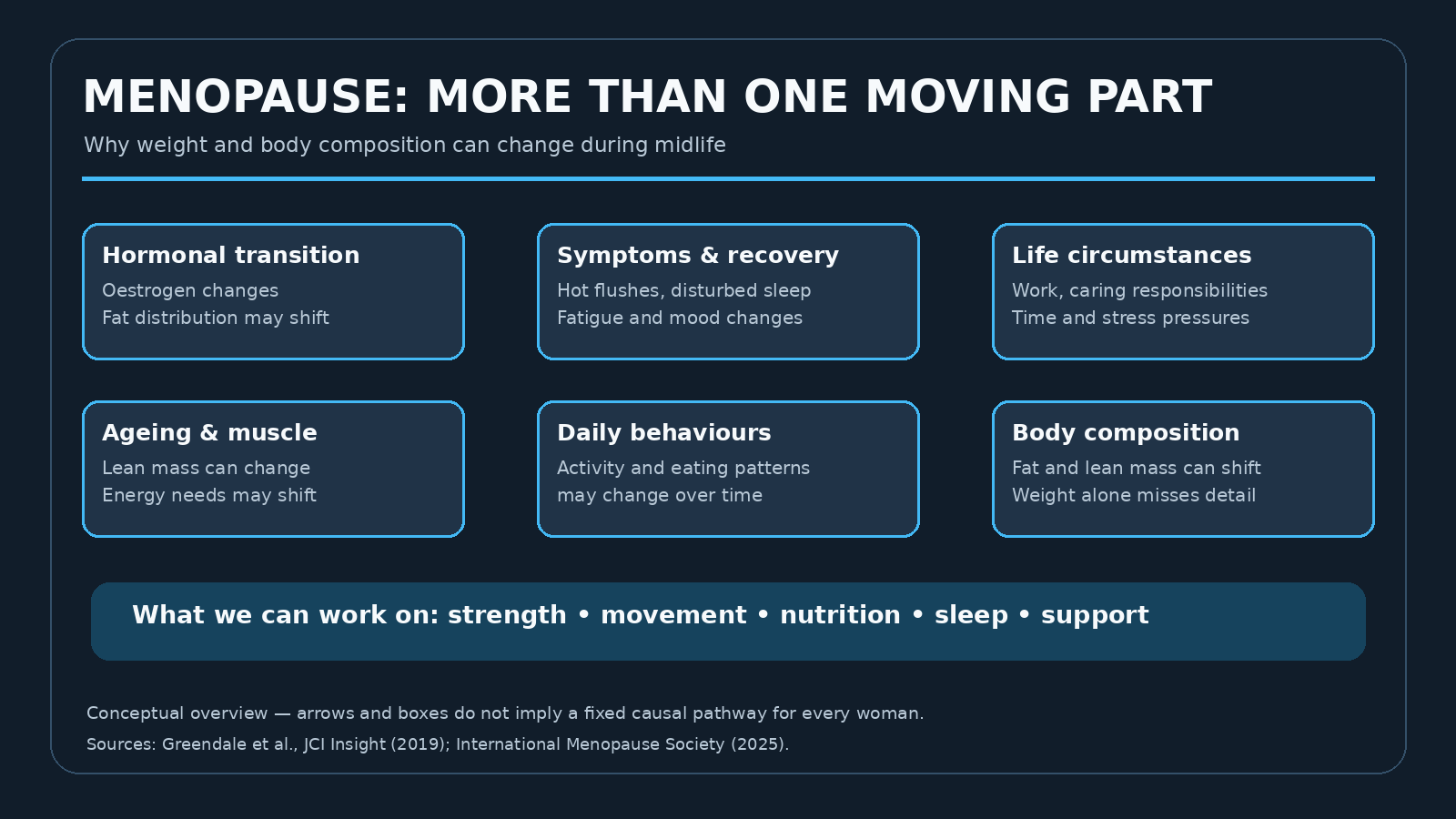
Original Fox Den illustration informed by Dr Alyssa Olenick’s presentation at The Mac-Nutrition Collective and published research by Greendale et al. (2019, 2021).
Declining oestrogen can influence where body fat is stored, with a greater tendency towards abdominal and visceral fat.
Hot flushes and night sweats can disrupt sleep, which may influence appetite, energy levels and physical activity. Muscle mass may gradually decline with age, particularly without resistance training.
Throw in work, family responsibilities, stress and the general chaos of everyday life, and you can see how things become more complicated.
It’s worth remembering that menopause and ageing happen at roughly the same time, making it difficult to separate their individual effects.
Energy balance still applies, but understanding what influences energy intake and expenditure is what makes those principles useful in the real world.
Your metabolism hasn’t suddenly packed its bags. Your physiology and circumstances may have changed.
A Better Way To Talk To Women About Menopause
At The Fox Den, we work with plenty of women going through perimenopause and menopause.
The last thing somebody needs when they’re exhausted, sleeping badly and struggling with changes in their body is to be made to feel they’ve somehow failed.
There’s a considerable difference between telling somebody they’re probably eating too much and moving too little, and acknowledging what they’re experiencing before helping them find a way forward.
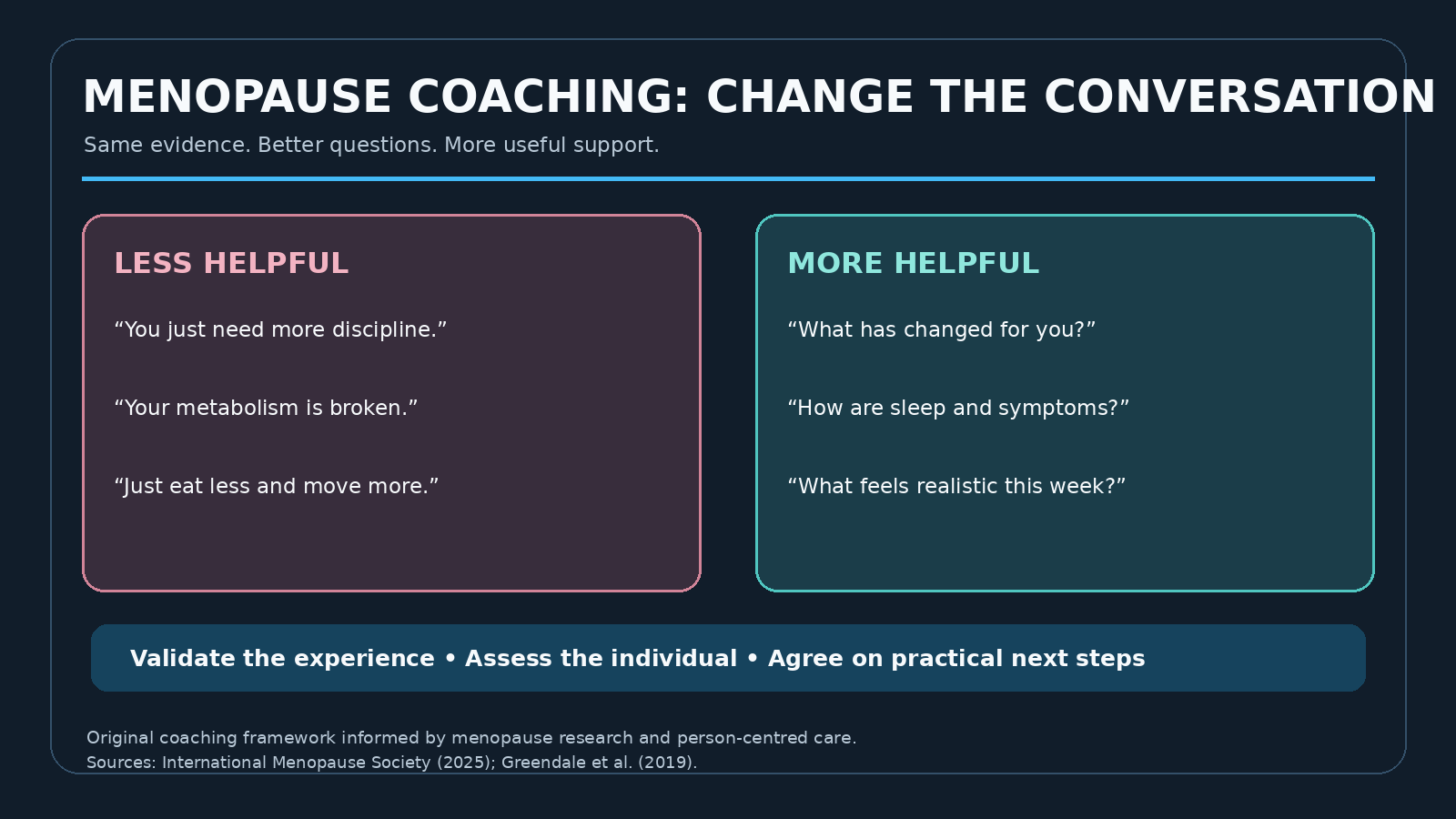
Original Fox Den coaching illustration inspired by Dr Alyssa Olenick’s presentation at The Mac-Nutrition Collective.
Both conversations eventually involve looking at nutrition, activity and lifestyle, but how we approach them matters.
Good coaching isn’t about ignoring the science. It’s about applying the science with a bit of fucking empathy.
Let’s Talk About Muscle
As we get older, we tend to lose muscle mass, particularly if we’re not doing anything to maintain it. Generally this starts from the age of 30.
It’s not just about how much muscle we have.
Strength, power and muscle quality matter too.
Getting out of a chair, walking upstairs, carrying shopping and catching yourself when you trip all require strength and coordination.
That last one is particularly important because when you stumble, your body doesn’t politely ask whether you’d like a few seconds to organise yourself.
You need to react, and you need to react quickly.
Now, this all seems doom and gloom so far but there is good news and this is that women can still build muscle and improve strength post menopause.
Progressive resistance training still works. You don’t suddenly need a special menopause-only training programme. Maybe if I marketed the Fox Den plans this way I may make more money.
You need appropriate exercises, sufficient effort, progression and consistency.
For many women, two or three strength sessions a week can make a huge difference.
Maintaining strength isn’t just about what you can lift in the gym. It’s about what you’re capable of doing outside of it.
Bone Health
Oestrogen plays a significant role in bone metabolism. As levels decline around menopause, bone breakdown can accelerate, contributing to reduced bone density and an increased risk of osteoporosis.
Osteoporosis if you’re not sure makes your bones more fragile and more susceptible to fractures.
Unlike changes in body fat, you can’t look in the mirror and see your bones becoming weaker, not even if you had some of those xray glasses you used to see advertised on the back of comics in the 80s.
You may feel absolutely fine.
Until something happens.
A stumble. A fall. A fracture.
Unfortunately the consequences can be far more serious than many people realise.
Why A Broken Hip Can Become Life-Threatening
Research has consistently found that older adults who sustain a hip fracture have a significantly increased risk of dying during the following twelve months.
Some studies have reported one-year mortality rates of approximately 12–25% among women following hip fracture.
That’s a fucking horrible stat.
To be clear, this doesn’t apply to every postmenopausal woman who breaks a bone. These figures relate specifically to hip fractures, predominantly in older populations, where age, frailty and existing health conditions influence outcomes.
However, why can a broken hip have such devastating consequences?
Often, it’s a combination of the injury, underlying health and complications during recovery:
- Loss of muscle and mobility: Older adults can lose strength and physical function rapidly during periods of inactivity.
- Blood clots: Reduced movement following injury or surgery increases the risk of deep vein thrombosis and pulmonary embolism.
- Infections: Immobility and frailty can increase the risk of complications such as pneumonia.
- Surgical complications: Major fractures and surgery place considerable stress on the body, particularly when existing medical conditions are present.
- Loss of independence: Some people never regain their previous mobility, requiring additional care and support with everyday activities.
Some of the increased mortality also reflects health problems and frailty that existed before the fracture.
Nevertheless, a single fall can dramatically change somebody’s life.
This is why maintaining muscle strength, bone health and physical function deserves considerably more attention.
Should Postmenopausal Women Lift Heavy Weights?
Yes, of course.
Bones respond to mechanical loading, and progressively loaded resistance training can help maintain or improve bone mineral density.
That doesn’t mean taking somebody who’s never lifted weights and immediately sticking a heavy barbell on their back.
It’s about developing confidence, learning technique and gradually increasing the challenge.
For one woman, that might mean lifting a barbell. For another, it might mean progressing from standing up from a chair to performing the same movement holding a dumbbell.
Heavy is relative to the person doing the lifting.
We also need to consider balance, coordination and power. Exercises such as faster sit-to-stands, step-ups and balance work can help develop the physical abilities needed to recover from a stumble.
We’re addressing two important aspects of fracture prevention: reducing the likelihood of falling and improving bone strength.
Neither eliminates risk completely, but both are worth working on.
No, Cardio Isn’t Suddenly Bad For You
Can we please stop telling menopausal women to avoid cardiovascular exercise because it raises cortisol?
Cortisol is a normal, essential hormone that helps regulate energy availability.
A temporary increase during exercise is a normal physiological response. It doesn’t mean your morning run is secretly making you gain belly fat.
Cardiovascular exercise supports heart health, fitness and wellbeing, and may also help reduce visceral fat.
Walk, run, cycle, swim or dance like no one is watching around your house.
You don’t have to choose between strength training and cardiovascular exercise.
You can do both.
I thoroughly recommend you do.
Nutrition Still Matters
You don’t suddenly need to eliminate carbohydrates or buy an expensive menopause supplement stack.
The fundamentals remain important:
- Adequate protein to support muscle maintenance and growth.
- Calcium and vitamin D to support bone health.
- Sufficient energy to support training and recovery.
- Carbohydrates to fuel physical activity.
- A varied diet containing plenty of fruit, vegetables, fibre and healthy fats.
Individual nutritional needs may change, but the basic principles don’t change.
Adapt The Training. Don’t Abandon It.
Exercising when you’ve barely slept, your joints ache and you’re exhausted can be considerably harder.
Some days, training might feel fantastic. Other days, the same session might feel considerably more difficult.
That’s where you learn to adapt.
Perhaps we reduce the load, change an exercise, shorten the session or allow more recovery.
Sometimes maintaining consistency is more important than chasing personal bests.
And if the menopause symptoms are significantly affecting your quality of life, speak to your GP or women’s health GP at your surgery about treatment options.
We can acknowledge genuine physiological challenges without treating women as if they are made of glass.
It’s Not About Being Smaller. It’s About Being Stronger For Longer.
At The Fox Den, some women train to lose body fat, others to improve confidence or fitness, and some simply want to keep doing the things they love.
All perfectly decent reasons.
The benefits of strength training extend far beyond what you see in the mirror.
It’s about carrying your own shopping, playing with grandchildren, getting up from the floor, going on adventures and remaining active and independent.
We need to spend less time frightening women about their hormones and more time helping them understand what they can do to support their long-term health.
The work you put into maintaining your strength today is an investment in the person you’re going to be ten, twenty or thirty years from now.
Training isn’t just about adding years to your life. It’s about giving yourself the best possible chance of enjoying those years with strength, confidence and independence.
If that means you’re still lifting weights, going on adventures, dancing at gigs and generally refusing to behave yourself in your seventies and eighties?
Even fucking better.
